Wednesday, November 4, 2009

Northern Lights; Cold Nights
By Tom Secrest


There are at least a thousand good reasons to visit Alaska, and the city of Anchorage is just one of them. It is the largest city in Alaska, with about one half of the entire state’s population; however, it’s not the capital. The capital of Alaska is Juneau and is a much smaller town.

Alaska was the 49th state to join the union and was purchased from the Russian Empire in 1867 for a pack of smokes and a bottle of vodka, or so they say. From the Russian point of view, it has to be, by far and away, the worst real real-estate deal ever! The sale price was about 1 Kc per hectare, and at that price the U.S. bought 172 million hectares.

Anchorage is sub-artic, but not by much. It sits on a peninsula protruding into Chickaloon Bay in the foot hills of the Chugach Mountains; at latitude 61 degrees, it is a bit further north than other well know northern cities like Oslo, Helsinki, and Stockholm. However, unlike these other cities, Anchorage does not benefit from warming influence of the Gulf Stream to moderate its winter temperatures. Oslo has an average January temperature range between –2 and –7 °C, while Anchorage has a range between –5 and –13 °C, although summer temperatures are about the same in all four cities.

Anchorage is not a place you drive to, even if it was an easy drive, which it’s not, the distances in this part of the world are enormous, which makes driving impractical at best. Fortunately, Anchorage has an airport with a variety of major carriers providing service on both national and international routes.

In the summer Anchorage looks like any other medium to large city. With a population of about 300,000 you can expect to find lots to do, great restaurants, and plenty of hotels. But while Anchorage may look fairly typical, it is, none the less, a frontier town. Alaska is a frontier state and virtually every town is a frontier town. The people that populate Alaska’s cities and towns are, in many ways, still possessed by the spirit of those that sought their fortunes by pushing further and further west and north in search of riches, in whatever form they might take. Of course few found gold or oil; but find it or not, if you didn’t have the frontier spirit, the cold and dark of Alaskan winters would have sent you packing back to the lower 48 a long time ago. The people who stayed are a special breed. They are warm and friendly, they love the outdoors and they love their special state.

With Anchorage as your base camp you can easily venture off in any direction; you don’t have to go far before you are in a wilderness that is beyond compare. If you’re an adventurer with some experience in hand-to-hand combat with bears, you can take an unguided hike up to Flattop Mountain Lookout. On the other hand, if you less combat oriented, you can have a bush pilot fly you to some idyllic lake for a bit of fishing or take a cruise along the coast. Regardless of what you decide to do, you’ll have a great time.

If you can stand a little cold, then late autumn or early spring is also a perfect time to visit. Perfect because when they come, they come in the cold and they come in the darkness and they dance and twirl about in the night sky. Ghostly shapes of green, blue, or red light up the night sky in one of natures most impressive displays. Alaska seems to be in just the right spot for these ethereal light shows. The northern lights alone are complete justification for a visit.

Don’t let the volcanoes, earthquakes (in 1964 Anchorage experienced the second largest earthquake ever recorded – the “Good Friday Earthquake” measured 9.2 on the Richter scale), bears, moose, or cold weather deter you. Pack your bags and your frontier spirit, and embark and an incredible adventure. Regardless of the time of year, you will come back with hundreds of photos and even more memories and stories from this remote, rugged, and beautiful place. Considering the location, it’s not a trip you’re likely to make very often, but it is definitely one you need to make at least once.

Glossary

* northern lights – polární záre
* entire – veškerý
* peninsula – poloostrov
* purchased from – zakoupený od
* real estate – nemovitosti; reality; realitní
* plenty – spousta, velké množství
* fairly – docela
* sought – hledaný
* whatever – cokoli, kterýkoli
* a long time ago – dávno
* breed – druh (o lidech), chovat
* wilderness – divocina, samota
* unguided – bez pruvodce, nerízený
* regardless – bez ohledu na
* twirl – tocit, vírit
* ghostly – strašidelný, duchovní
* justification – oduvodnení, ospravedlnení
* earthquake – zemetresení
* considering –vzhledem, s ohledem na

Wednesday, October 28, 2009

The Autumn Gold of Vermont

Vermont is a unique state with a unique past. Almost everyone knows that it is somewhere in the New England region, but it is often confused with its Eastern neighbor, New Hampshire. The two states have very similar shapes matching each other the way two pieces of a rectangle match if separated by a diagonal line. This similarity of shape, size, and proximity is every forth graders geography nightmare. It is in the 4th grade that school children across America are usually learning the names, capitals, and locations of all the states. And without fail, there is the evitable quiz involving an outline of the United States on which children are supposed to label each state and draw a circle or put a point in approximate location of the state’s capital. The trauma of this single event might, and I emphasize might, explain why so many American, perhaps half, never leave the comfortable confines of their home state borders.

Vermont is the 43rd smallest state; however, if you exclude the part that is water, it falls to the 45th smallest state, so it’s not hard to appreciate why excluding the water part is so abhorrent to them. It is the 2nd least populace state, coming in just behind Wyoming and it was the 14th state to join the union. Originally the Native Americans Indians thought the area belonged to them. That silly, although probably unimpeachable, notion lasted until 1609 when the French decided that, more than likely, it belonged to them. The British, after many years of thoughtful reflection and a long bloody war briefly took possession in 1763. In 1777 Vermont declared itself a free Republic and remained that way until it joined the union in 1791. The constitution of Vermont was one of the first constitutions in the Americas and was clearly the first to abolish slavery and provide for male suffrage. On examination, many of the parts of the Vermont constitution seemed to have been incorporated into the final version of U.S. constitution which would be drafted ten years later.

With Vermont’s history behind us, it is time to turn our attention to the best part of Vermont, its color. Both Vermont and New Hampshire can, perhaps equally, claim to be the fall foliage capitals of America. Vermont has a mainly rural history and beautiful dairy farms still dominate the landscape, a landscape unaffected by the ravages of overpopulation, deforestation, or industrialization. Each year starting, in September, the countryside begins to change. The days are a little less warm and the nights start getting slightly nippy. The leaves of the oak and maple trees begin there magnificent transformation from the deep green of the warm months of July and August to the fiery blaze that heralds the coming of winter. It’s not only the leaves that change, the countryside is also littered with pumpkin patches and as the days of September fade into the days of October, children start to become anxious for October 31st, when the pumpkins are carved and Halloween and trick-or-treat arrives.

There is no place like autumn in New England, with its white and red painted farm buildings; little, old steepled churches with their disproportionately tall spires; three-beam wooden fences, some painted, some not; covered bridges that continue to stand in complete defiance of their age and the passage of time; and the color, the incredible colors of autumn.

So on your visit to Vermont make time for a long drive in the country. Pack a picnic and enjoy lunch in a cozy roadside park. Afterwards, find a small restaurant, chat a while with the waitperson, the owner, and some of the locals, have some warm cider and relish the delicacy of a hot slice of freshly baked apple or pumpkin pie, alamode if you prefer.

Last week’s film question: Who starred in the film Groundhog Day?
Answer: Bill Murray and Andie MacDowell.

Trivia question of the week: Of the 44 U.S. presidents, Obama being number 44, how many came from Vermont?

Glossary

  • confused – popletený
  • matching – shodný, srovnatelný
  • rectangle – obdélník, čtyřúhelník
  • nightmare – noční můra, strašák
  • evitable – vyhnutelný (zřídka)
  • supposed – pravděpodbný, údajný
  • approximate – přibližný
  • emphasize – zdůrazňovat
  • abhorrent – nepřípustný, neslučitelný, odporný
  • thought to be – považovaný za
  • unimpeachable – nesporný, spolehlivý
  • possession – majetek, država
  • abolish – zrušit, anulovat
  • slavery – otroctví
  • suffrage – hlas (volební), volební právo
  • equally – stejně
  • deforestation – odlesňování
  • nippy – chladný, řezavě studený
  • oak – dub
  • maple – javor
  • littered with – zaneřáděný
  • pumpkin – dýně
  • patches – políčka
  • fence – plot, oplocení, ohrada
  • cozy – útulný
  • cider – mošt, víno
  • relish – pochutnat

Saturday, September 12, 2009

Punxsutawney, PA; where rodents forecast the weather

Punxsutawney, PA; where rodents forecast the weather
By Tom Secrest

Pennsylvania is well known for three cites; Philadelphia, which is on the far south-eastern side of the state; Pittsburgh, which is, more or less, in the south-western part of the state and Punxsutawney. In case you’re interested, none of these cities are the capital of the state – that would be Harrisburg, which is in the south-central part of the state. Unlike most states, where the state borders appear to have been drawn by blind and drunk bureaucrats, Pennsylvania’s borders appear to have been drawn by 3 engineers (north, south and west) while the east border was drawn by a blind and drunk bureaucrat.

However, Pennsylvania sits in a very congested area of the U.S. and was the 2nd of the original 13 colonies. It shares its eastern border with Delaware, the 1st colony, New Jersey, the 3rd colony, and New York, the 10th colony. Why 3 out of 4 borders are as straight as an arrow, is perhaps still a mystery.

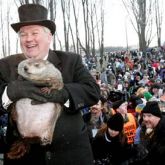
Philadelphia and Pittsburgh are fairly large U.S. cities, with Philadelphia being number 6 (population 1,447,395) and Pittsburgh being number 60 (population 310,037) and coming just after New Orleans at number 59; although these rankings are pre-hurricane Katrina, Pittsburgh may have moved up since then. Punxsutawney on the other hand has a population of 6,271, which means its ranking relative to other towns and cites is probably unknown. For Philadelphia, there is the Liberty Bell, for Pittsburgh, there’s – there’s – okay I’m not sure there is anything special about Pittsburgh. Oh I almost forget, it is the home of the Pittsburgh Steelers Football team; the only team to win the Super Bowl 6 times; I new there had to be something special about Pittsburgh. As for Punxsutawney, pronounced “puhngh-suh-taw-nee,” its claim to fame can be seen in the picture. You might be thinking, who is that man, why is he dressed that way, and why is he holding a big fat rat? However, it is, in fact, the fat Sciuridae that is famous, not the man holding it; so you should be thinking who is that big fat rodent and why is that oddly-dressed man holding him? The man is, no doubt, the distinguished and honorable Mayor of Punxsutawney and the fat rodent is Punxsutawney Phil, the furry weather forecasting beast that each year, on February the 2nd, better known as Groundhog day, forecast whether winter will end early or will continue for an additional 6 weeks.

The story goes something like this; starting back in 1886, when the tradition, at least in America, was born, Phil, which is actually a groundhog and not really a fat rat, is pulled from his hole each year on February 2nd and if he sees his shadow and returns to his hole then there will be six more weeks of winter. On the other hand, if he doesn’t see his shadow, spring will arrive early that year. The celebration of Groundhog Day is not uniquely American. It has its roots perhaps in the German Candlemas Day or perhaps even further back with pagan rituals surrounding Imbolc.

Since Phil has achieved celebrity status, his life has become much more leisurely, and instead of living in some hole in the earth like a run-of-the-mill Hobbit, Phil now lives the “Life of Riley” in the town library and his every need is catered to by a select group, which call themselves the “Inner Circle.” Members of the Inner Circle tend to be elderly gentlemen who dress in tuxedos and wear top hats. This is perhaps fitting, considering the almost royal status of Phil.

So each year the festivities begin in the early morning freezing temperatures of Punxsutawney. Town’s people, tourist, local school bands, and a media scum from all over America; converge on Gobbler’s Knob for the official reading of the spring arrival prognostication. Of the 123 predictions, Phil has only predicted the arrival of an early spring 14 times. Amazingly, the only year in which there was no pronouncement was in 1943, apparently that year Groundhog Day was cancelled due to war. Of some special interest, relative to global warming, 8 of the 14 predictions for early springs have been since 1983 and 5 of the 14 have been since 1990.

So if you are ever in the area, regardless of season, make the extra effort and take the extra time for a little detour to Punxsutawney. You’ll like the town, you’ll like the people and you will be able to say you met the most famous rodent in the world.

The answer to last weeks quiz is: Nurse Ratched was the evil nurse in the 1975, Milos Forman film, One Flew Over the Cuckoo’s Nest.

This week’s quiz: Who were the leading male and female actors in the 1993 movie, Groundhog Day?

Glossary

* in case – v prípade, jestliže
* congested – preplnený
* ranking – razení, pozice
* pronounced – výrazný, vyslovený
* rodent – hlodavec, krysa
* oddly – zvláštne
* no doubt – nepochybne, nesporne,bezpochyby, rozhodne
* furry – chlupatý
* Groundhog day (US) – Hromnice
* pull – táhnout
* uniquely – výhradne, jedinecne
* root – základ, zdroj
* pagan – pohanský
* surrounding – okolní
* achieved – doáhnout, docílit
* leisurely – klidný, neuspechaný
* catered – zásobený
* tend – mít sklon, inklinovat
* tuxedos – smoking
* fitting – vhodný, príhodný, priléhavý
* considering – vzhledem, s ohledem na, se zretelem
* converge – smerovat, soustredit
* prediction – proorctví, veštba
* amazingly – prekvapive, neuveritelne
* apparently – zrejme, patrne
* regardless – bez ohledu na

Monday, September 7, 2009

Remember the Alamo

Remember the Alamo
By Tom Secrest

San Antonio Texas sits at the cross-roads of two major highways. I35 – the I stands for Interstate highway – a north-south highway, which runs from Duluth, Minnesota on the Canadian border to Laredo, Texas on the Mexico border; spanning a distance of 2518 km and I10, an east-west highway, which runs from Jacksonville, Florida on the east coast to Santa Monica, California on the west coast; covering 3959 km.

San Antonio, named after St. Anthony, is about half way along I10, but, as you would expect, pretty far south along I35. The city was settled and named by the Spanish in 1691. It may come as a surprise that San Antonio is the 7th largest city in the U.S. and the 2nd largest in Texas; Houston being the largest city in Texas and the 4th largest in the U.S.

In many ways it is a typical modern Southwestern city, full of lots of tall glass skyscrapers with a booming central business district. Outside of this area are the “burbs,” which is short for “suburbs;” discreet neighborhoods segregated along ethnic, racial, social, historical, and financial lines. During the day the burbs empty and everyone spills into the downtown area, where all the different groups seem to get along just fine and the artificial barriers that separate them in the evenings vanish in the bright sun and heat of the day.

Running through the center of the city is a narrow river, no more than one tenth the width of the Vltava passing through Prague; even a child could throw a coin across it. The river runs slow and quiet and because it is so narrow, it is dwarfed and hidden by the buildings around it. In fact, it would be easy to spend a week in San Antonio and never know there was a river meandering through the middle of the city. In the searing heat of a Texas summer, the river creates its own microclimate. With sidewalks along both banks in the shade of overarching trees and a gentle continuous breeze, the river has become a Mecca for shops, restaurants, and people trying to elude the heat. This microclimate is now better known as the San Antonio River Walk. At night the entire areas takes on a magical festa spirit, transformed by hundreds of thousands of tiny lights strung in the all trees along and across the river. Sidewalk cafes are everywhere and there is no shortage of the best Tex-Mex cuisine in the world.

Remember the Alamo! Originally called Mission San Antonia de Valero, it was home to missionaries. The targets, or subjects, of their good will and enlightenment were, of course, the Native, and by their standards, uncivilized, American Indians. The now historic site was constructed in 1724. Sometime in the early 1800s Spanish soldiers named the mission the Alamo. Alamo is Spanish for cottonwood. Cottonwoods are a type of tree, a tall, majestic, water loving tree, which grows abundantly in the moist soil along the banks of the river. Each spring, they release tiny fluffs of white cotton-like fibers which float on the breeze and slowly fall to ground like big snow flakes.

The Alamo was the site of a significant battle in the Texas Revolution. The battle, which was ultimately lost by the Texians and Tejanos, involved a who’s who of prominent citizens of the time; William Travis, Jim Bowie, and Davy Crockett just to name a few. Like the river, the Alamo is almost invisible. The city has built itself around the old mission the way a vine wraps itself around an old building. So invisible, in fact, you could walk within a block of it and never sense it was there.

But it is there, and like so many places where battles were fought, it has a story to tell. A story about a battle, a battle where few stood against many and died for something they believed in, but would themselves never live to see or enjoy. Here men and women died for the freedom of others and in so doing paid a very high price indeed, and that makes it hallowed ground – ground worth finding and ground worth visiting should you ever pass that way. So when you next hear the expression “Remember the Alamo!” you’ll understand that they don’t mean remember the old mission building, they mean remember freedom, the cost of freedom, the price of freedom, and remember those that made the ultimate sacrifice in its name.

Glossary

* highway – hlavní silnice, dálnice (v USA)
* border – hranice
* spanning – sahající
* coast – breh, pobreží
* covering – pokrývající
* settled – obydlený, založený
* skyscraper – mrakodrap
* suburb – predmestí
* booming – rozvíjející se, vzkvétající
* vanish – zmizet
* coin – mince, peníze
* dwarfed – zakrslý, zakrnelý
* searing – zpražující, pálivý
* sidewalk – dláždený chodník
* tiny – malý, drobounký
* strung – napnutý
* shortage – nedostatek
* enlightenment – osveta, poucení
* cottonwood – americký topol
* cotton – bavlna
* abundant – hojný
* fluff – prach, chomác, chmýrí
* to sacrifice – obetovat se

Monday, August 31, 2009

The Path Less Traveled – Colorado

The Path Less Traveled – Colorado
By Tom Secrest

The state of Colorado is inextricably linked to its famous mountains, the Rockies, and its famous “Mile High City”, Denver. Denver gets its nickname by sitting on the eastern high plains of the Rocky Mountains at exactly 5,280 feet (1609 m) above sea level. The Rocky Mountains stretch from British Columbia in the north to the Rio Grande River, along the border with Mexico, in the south. Oddly enough, Denver as well as most of the best ski areas share the same latitude as Madrid, although, any similarities stop there.

Of those things lauded, Colorado’s nature surely outranks its cities, but not necessarily its smaller towns. For it is in the smaller towns, deep in the mountains, that the real spirit of Colorado can be found. Most of the beautiful ski resorts and the small towns that grew up around them are a product of the incredible wealth that Colorado has attracted. Names like Vail, Aspen, Steamboat and Winter Park, are synonymous with the rich and famous. If you ski and have money these are the places to be in winter. Even if you don’t ski, these are the place to be seen, which for celebrities is, perhaps, more important than the actual skiing.

Ski resorts, can be divided into three varieties: old money, new money and everyone else. Old money is the proper type, the kind that runs in families and is passed on from generation to generation. The old money goes to Vail, by far the most expensive skiing in Colorado, maybe in America. New money or the nouveau riche, are those that were born into modest or working class families and through hook or crook became filthy rich. But as the nouveau riche are fond of saying, it’s the riche that counts. Everyone else; well that’s pretty much exactly what it sounds like. And depending on the extent and the circumstances of your wealth you frequent to the appropriate ski resorts.

Unlike ski resorts, people can be divided into lots of different varieties and if you fall squarely into the group that isn’t particularly interested in the hustle and bustle of ski resorts and tend to favor adventures that take you off the beaten trail and on to paths less traveled, then Colorado is full of places made just for you.

Most likely you will fly into Denver International Airport; once you arrive, rent a car and head straight for the mountains. The airport is located between Denver and the Rockies, along the main east-west highway over the mountains. As you start you ascent you may notice a brown cloud off in the distance behind you. That would be Denver, like most big, high altitude cites, Denver fights a constant battle with air pollution, and in the winter the pollution usually wins. But you’re headed up and to the west, where the air is clean and views are breathtaking. After an hour or so you will come to the exit for Winter Park – take it, don’t let the name scare you, there are no check points where you will have to substantiate the extent and heritage of your wealth. Instead, what you will find is an incredible switch-back road leading high up into the Rockies.

Since you will be passing through Winter Park, why not stop and enjoy a walk-about, do some window shopping at the seemingly unlimited number of designer boutiques, then warm yourself with an expensive cup of hot chocolate. Keep your eyes open, there is no telling who you might see as you wonder around the quaint little Bavarian town. Americans associate everything mountain with Bavaria, so all ski resorts look a lot like Berchtesgaden, complete with cuckoo clocks. After you have roamed Winter Park, it is time to continue to your destination, which, by the way, is Granby. Granby is an old Colorado frontier town and doesn’t look at all Bavarian. As you drive towards Granby you will see some signs you’re probably not used to seeing. You’re now in elk and bear country, so drive carefully.

Granby functions nicely as a base camp for exploring what will seem like an unlimited wilderness. As you explore you will, from time to time, find ghost towns. Once thriving little mining towns, the now deserted buildings stand as the only reminders of places that both people and time have forgotten.

No matter where you’re from, once you settle into Granby you’re a backcountry cowboy. So put on your boots, saddle up your horse and enjoy every second you spend on the path less traveled.

Glossary

* path – trasa, cesta
* inextricably – neoddelitelne
* nickname – prezdívka
* feet above – stop nad
* to stretch – táhnout se, prostírat se
* oddly enough – kupodivu
* latitude – zemepisná šírka, rozsah, svoboda
* lauded – velebený
* to outrank – pretrumfnout
* incredible – neuveritelný
* squarely – prímo, rovnou
* nouveau rich – zbohatlík
* modest – skromný, prostý, nenárocný
* by hook or crook – jakýmikoli prostredky
* filthy rich – desne zazobaný
* be exactly what - být presne to, co (...)
* circumstances – okolnosti, pomery
* to head straight for – smerovat k
* altitude – nadmorská výška
* breathtaking – beroucí dech
* to substantiate – zduvodnit
* quaint – podivný, zvláštní, kuriózní
* elk – los
* to seem – zdát se, praavdepodobne, patrne
* wilderness – divocina
* ghost – duch, stín, stopa
* thriving – kvetoucí, prosperující
* reminder – pripomínka, památka, memento
* backcountry – zapadákov
* to saddle up a horse – osedlat kone

Friday, August 21, 2009

Dear Hawaii, Happy 50th Birthday

Dear Hawaii, Happy 50th Birthday
By Tom Secrest

Almost everyone has heard about the attack on Pearl Harbor, the pivotal event that officially brought the United States into World War II. Roosevelt described it as “a date that will live in infamy.” If you ask most Americans what happened on December 8, 1941, if they know at all, they will say it was the day the Japan attacked the United States at Pearl Harbor on the Hawaiian island of Oahu.

What they may not know, in fact, I would guess most don't know, is that Hawaii was only admitted to the Union on August 21, 1959, almost 18 years after the attack on Pearl Harbor. Japan had not technically attacked the United States; they had attacked a naval base on a U.S territory, a territory since 1900. Hawaii belongs to a small, elite group of states (The Republic of Hawaii, the Republic of Vermont, the Republic of California and the Republic of Texas) that were independent republics before they became states.

In just a little more than a month, Hawaii will celebrate its 50th birthday as part of the United States of America.

Hawaii consists of several hundred islands, the best known of which, Oahu, is the home of its biggest city, Honolulu, and host of the famous naval base. The second best known island is Hawaii or the “Big Isle” a term which is often used to avoid confusion with the name of the state as a whole.

The biggest problem in visiting Hawaii is that it is literally in the middle of nowhere. Ideally your journey would start on a cruise ship in LA or San Diego. But realistically, it will start in LAX, Los Angeles Airport, or SFO, San Francisco Airport. To cover the 3800 km from the west coast will take about 5 hours. When you arrive you will be greeted by a true tropical paradise.

No doubt you can visit other, perhaps equally, beautiful tropical islands, but in Hawaii you will be able to drink the water and there is little risk of returning home with some life-long parasitic infection. For sun lovers, an average high temperature of 29 ºC (85 ºF) combined with a refreshing sea breeze, makes Hawaii exactly what the doctor ordered.

Most mornings start with a gentle shower; just enough to get things wet and keep everything an intense green, the description of which is beyond words. Afternoons bring widely scattered thunderstorms, which last an hour or so and then give way to cooler, less humid evenings. Evenings are a time to relax and enjoy the true hospitality of the islands. Every hotel has an open lobby that doubles as a tropical forest, complete with the sweet smell of flowers and the songs of tropical birds; and every restaurant offers Mi Ties, great food and a relaxing end to a busy day; perhaps a day of swimming with the turtles in Hunauma bay (don't forget the sun screen), a climb up Diamond Head, a visit to the Arizona Memorial, a fast walk over hardened lava that is still hot enough to melt your shoes, or a quick flight to the Big Isle to explore the snow capped peak (4200 m) of Mauna Kea.

So forget about destinations in Malaysia or any other places that require vaccinations, and indulge in the ultimate tropical experience; indulge in Hawaii. And if you hurry, which is generally frowned upon and widely discouraged in Hawaii, you can be there for Hawaii’s 50th birthday bash.

Glossary

* pivotal – klícový
* event – událost
* infamy – hanba
* I would guess – rekl bych
* naval base – námorní základna
* to consist of – sestávat z
* to avoid – vyhnout se
* literally – doslova
* cruise ship – výletní lod
* to greet – vítat, uvítat
* average – prumer, prumerný
* breeze – vánek
* scattered – roztroušený, rozptýlený
* thunderstorm – bourka
* turtle – želva
* to require – vyžadovat
* to indulge – doprát si, oddávat se, hovet si
* frowned – zamracený
* bash – oslava, mejdan

Saturday, August 15, 2009

Silent Stones

Silent Stones
By Tom Secrest

When people think of Washington D.C. many things come to mind. Since it is the nation’s capitol you would expect it to be full of monuments reflecting the history of the nation, and it is full, full to the brim. Tributes to the best known presidents, the obelisk of the Washington Monument with it’s beautiful reflecting pool; the Pantheon-like Memorials to Lincoln and Jefferson, the National Gallery and the Smithsonian Museum can all be found within walking distance of each other. Of course there is the house at 1300 Pennsylvania Avenue (affectionately known as the White House) and at the other end of the avenue sits the Capital, the home of the U.S. House and Senate. Considering the close proximity of these branches of government, Americans and perhaps others as well, stand in utter disbelief at how little actually gets accomplished.

In the spring, the city is awash with pink and white cherry blossoms, and in places it is possible to feel like you are taking a leisurely walk through colonial America. The monuments, museums, famous restaurants, these are all places worth visiting; but there is something else to see, something not always mentioned in the guidebooks, a place that is visited, but less than it should be.

Across the Potomac River are the bedroom communities of Virginia. And every day swarms of people cross a handful of bridges to go to work in Washington. One of those bedroom communities is called Arlington, Virginia. Arlington is perhaps best known as the home of the Pentagon, but the city itself is certainly worth a visit and still retains some of the old colonial charm of its past. But there is something else in Arlington, a cemetery, the Arlington National Cemetery.

For whatever reason, cemeteries are not popular tourist destinations. But this is not just any cemetery; it is the nation’s military cemetery. Beneath 2.5 km2 are more than 300, 000 sons and daughters, but mostly sons, from wars dating back to the American Revolution all the way through to Afghanistan and Iraq. Some died peaceful deaths; most died violent deaths, in distant countries on battlefields near cities, the names of which they could not pronounce. Some were famous, John F. Kennedy can be counted among the 300, 000, but some have no name, and for them there is a special tomb, a perpetually guarded tomb, the Tomb of the Unknowns. The tomb has four crypts; interred are the remains of an Unknown from WWI, WWII, and the Korean War. The forth, the Unknown from Vietnam was later identified and disinterred; the crypt has remained empty since. There is a strange serenity in this cemetery, and wherever you look you see things on which to reflect, which perhaps explains its lack of appeal to everyday tourists. Tourism is about looking to see things around you and this place is about looking to see things inside you.

So if you get to Washington, get on the blue line and take the short journey to Arlington National Cemetery. Go early, before others arrive, when it is silent and still, when you can stand alone among the dead and see the terrible price of both freedom and folly, but more importantly, listen – listen to the stones tell you their stories; stories of hopes and dreams, of wants and desires, stories of what they could have been, but never were, and never will be.

Glossary

* brim – naplnit až po okraj
* affectionately – duverne, laskave
* utter – naprostý
* disbelief – neduvera, neochota, pochybnost, skepse
* leisurely – klidne, nenucene, bez spechu
* swarm – hemžení, hejno
* handful – hrstka
* cemetery – hrbitov
* violent – násilný
* battlefield – bojište
* interred – pohrbený
* remains – ostatky, telesné zústatky
* disinterred – vyhrabaný